This month, there were some non-computer news that I felt worth paying attention to.
One thing I've read is this analysis of the oddities on the stock market last month (some popular computed numbers did not go up the way they were expected to as a result of companies being more profitable than expected). The theory there is that the previous long period of “numbers go up” was powered by the commitment of the Japanese government to an artificially low central bank interest rate and this is now suddenly changing. I'm not sure I buy it the theory yet, but it pushed me to research how institutional investors leverage one country's guarantees to generate profit elsewhere.
Another thing is that a Chinese lab was able to build a big machine that converts heat to electricity (a power plant) using supercritical CO₂ to move the heat around instead of steam. It's actually producing real grid electricity already. This is a big deal, because all steam-based plants (regardless of fuel: coal, gas, nuclear, etc.) pay an efficiency loss due to the friction of the water moving around, and supercritical CO₂ avoids that. There is a scientific article that explains this and I also found a nice explainer video. Supercritical CO₂ is also better at moving heat around, so they were able to reuse leftover heat from the nearby steel plant as energy source which is also a first.
I also found this article on Chinese energy infrastructure. The text is light on details, but the pictures are breathtaking.
In related news, solar and wind energy supplied more power than fossil fuels throughout the EU in 2025, for the first time ever since the industrial age started. It's also a trend so it's likely only going to get better from there.
❦❦❦
Perhaps the article that most impacted the way I think is the meta-analysis Recent discoveries on the acquisition of the highest levels of human performance by Arne Güllich, Michael Barth, David Z. Hambrick and Brooke N. Macnamara (PDF here). Its main finding:
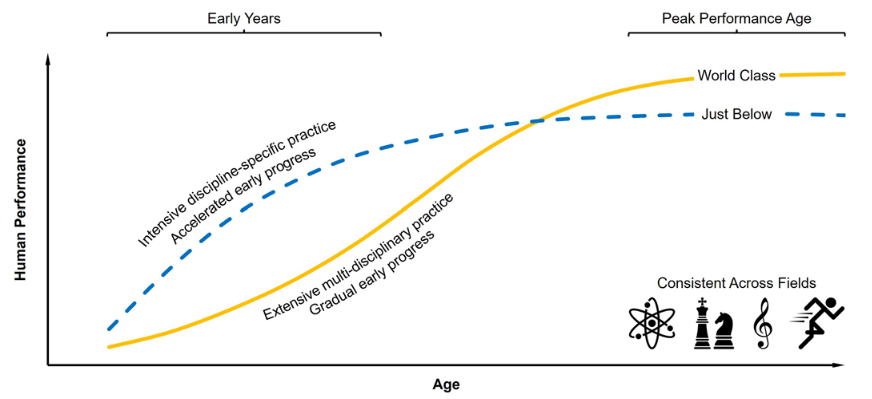
“The development of the highest levels of human achievement. Across domains, world-class performers, compared with peers performing just below this level, engaged in more multidisciplinary practice and showed more gradual performance progress through their early years.”
The two takeaways:
- people who are good at what they do in youth become good by focusing on one thing and staying focused. In contrast, people who become good at what they do later in life become good by being multidisciplinary.
- people who are good at what they do in youth eventually plateau, at a lower level than people who become good later in life.
Really, the detailed findings are definitely worth reading with some attention. This is top-notch science.